Time Geography

Time geography is an approach in human geography introduced by the Swedish geographer Hägerstrand in the mid 1960’s. The concept of time geography includes an interesting tool to visualise the spatial dimensions of human activities: the space-time path. Let’s have a look at an early example of the space-time model, and then apply it to the contemporary workplace.

Hägerstrand came up with this idea of a space and time framework to illustrate how a person finds and navigates their way in spatial environments throughout the day. The vertical y-axis represents time, the X+Z axis (horizontal + third dimension) represents geographical space, and the line is the person’s space-time path. In the example above, you’ll see that the person remained in one place, home, for the first part of the day (~6:15-7:15 am), to then move through time and space to get groceries before continuing to their place of work.
Aside from visualising a person’s activities in a geographic context, the space-time framework can also give us insights into the limitations and constraints about how humans allocate scarce time among activities in geographic space. The below space-time prism represents a set of all possible paths that an individual can take given their ‘time budget’.
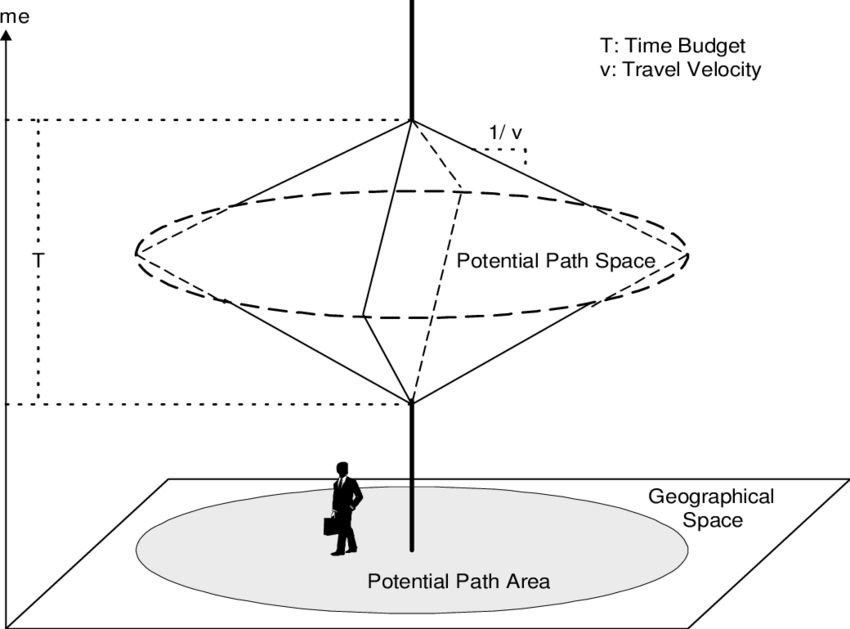
Hagerstrand identifies three key constraints categories that affect individual's movement and activities (3):
Coupling Constraints: These constraints involve the need for individuals to be in specific locations at specific times to interact with other individuals or to access certain resources. For example, think about scheduling an appointment with your doctor, which requires both of you to coordinate your day around that same time and place.
Capability Constraints: Limitations on human movement due to biological or physical factors. These constraints can include the need for sleep and food, the physical ability (e.g. walk/run) or transportation accessibility to move from one place to another, and the time needed to perform various activities.
Authority Constraints: These are the restrictions placed on the use of space and time by external authorities, such as laws and regulations. For example, specified opening hours of shopping centres, parks or museums, or maximum driving speed limits.
Where it becomes really interesting is when you do this type of analysis for thousands of people and overlay their different space-time paths. We will see certain clusters, patterns and relationships emerge, gaining insights into social interactions and accessibility. This can also be a valuable tool in urban planning and policy making for example as it can help help in understanding the spatial and temporal dimensions of urban processes, such as commuting patterns, land use, and the provision of urban services (think fire and ambulance services and the time it takes to get to the place of emergency).
Time Geography & The Workplace
By now you’ll have seen that time geography helps in visualising and understanding how individuals adapt to the constraints and affordances of their environments, and how their behaviours are influenced by spatial and temporal (time) factors. These three factors (behaviour, space, time) are incredibly important too, when designing a new strategy for your workplace. The below figure outlines this in more detail:

Now, let’s create a space-time path for a worker in a workplace. Below you’ll see a simplified version of a potential path of a worker. This model could help us visualise what “A Day in the Life Of” (DILO) a worker looks like. By looking at the figure below, we can easily understand someone’s movements, however, there are some important limitations using this method to visualise workplace pathways and understand behaviour. Can you identify the constraints of this model?

In the next newsletter we will explore the limitations of this model when applying it to contemporary workplaces, especially in this day and age of flexible working (hint!).
Stay tuned and I look forward to continuing this topic in the next edition and to hearing your ideas!


Comments