top of page
Read. With. Me.
I'm excited to introduce Read.With.Me! Join me as I share insights from books in human geography and explore their relevance to workplace strategy.
All Categories
19:42
Tica Masuku
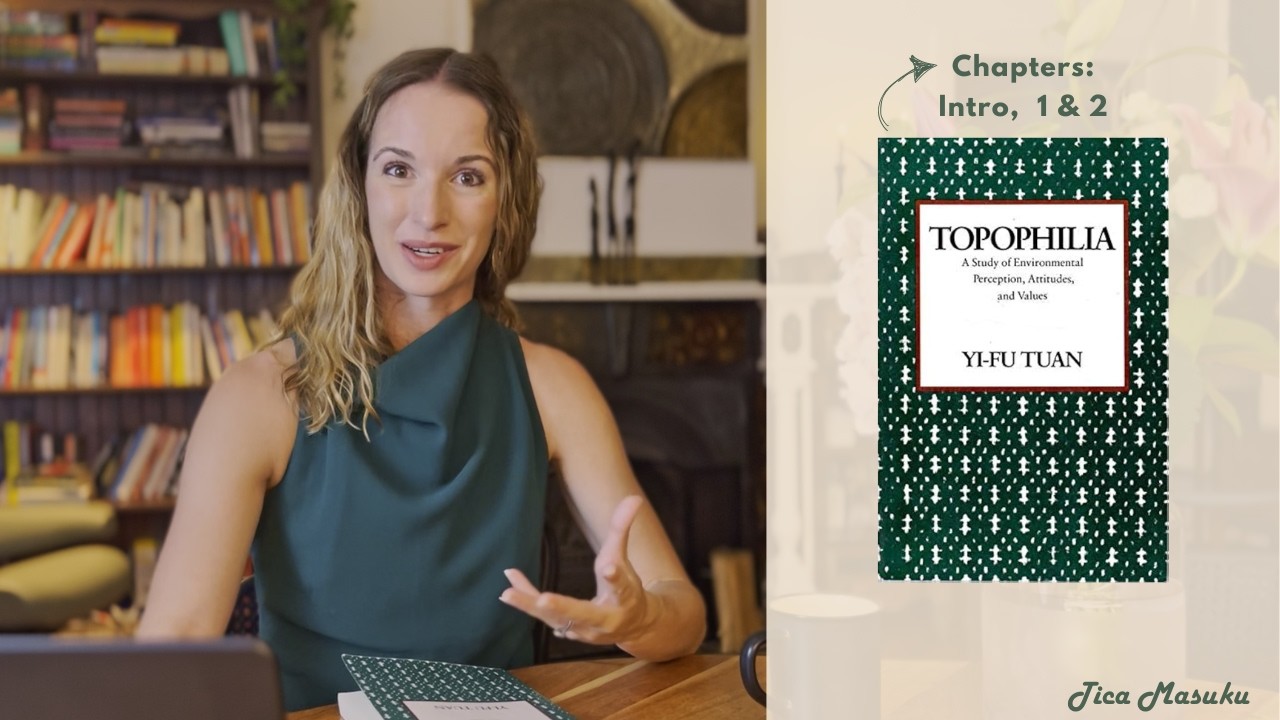
Topophilia 📚 Chapters 1 & 2, Book Insights | Read.With.Me. Ep.1
What makes us form deep emotional connections to the places we inhabit, and what does that mean for how we experience work?
Why Do We Fall in Love with Places? | Topophilia & the Workplace | Read.With.Me Ep.1
In this first episode of Read.With.Me., I introduce the series and dive into the opening chapters of Topophilia by Professor Yi-Fu Tuan, one of the founding texts of modern human geography. Written in 1974, Topophilia explores how human beings develop meaningful attachments to place. In an era when so much of our work has migrated into digital space, its insights feel more urgent than ever.
In this episode we cover:
- What topophilia means and why the love of place matters to workplace strategy
- How our five senses shape our experience of place, and what makes human perception unique
- Why sight is considered the most objective and distant of our senses, while hearing engages us far more emotionally
- What sensory deprivation looks like in knowledge work and what we can do about it
I also share a personal reflection on place attachment. Growing up cycling through the paddocks of the Netherlands, and what happened to that sense of topophilia after a decade in Australia.
📚 Book: Topophilia: A Study of Environmental Perception, Attitudes, and Values by Yi-Fu Tuan (1974)
Available here: https://amzn.to/3YMEHpQ
🎓 Perfect for: Workplace strategists, HR professionals, architects, designers, human geography students, and anyone curious about why certain places hold special meaning.
🔗 Read the essays: ticamasuku.com/essays
💌 Subscribe to the newsletter: ticamasuku.com
🔔 Subscribe for more insights on human geography and workplace strategy
📍 Next episode: Topophilia, Chapters 3 & 4
Follow me:
LinkedIn: linkedin.com/in/ticamasuku
X: x.com/TicaMasuku
Website: ticamasuku.com
Posts and comments on this platform reflect my views and opinions and not those of my current, past, or future employers.
#HumanGeography #WorkplaceStrategy #Topophilia #YiFuTuan #PlaceAttachment #WorkplaceExperience #EnvironmentalPsychology #WorkplaceDesign #ReadWithMe #PlaceMaking #geography
@ticamasuku

16:50
Tica Masuku
Topophilia 📚 Chapters 3 & 4, Book Insights | Read.With.Me. Ep.2
How do we make sense of the spaces around us, and what do our psychological responses to place reveal about how we should design workplaces?
How We Psychologically Structure Our Environments | Topophilia & the Workplace | Read.With.Me Ep.2
In episode two of Read.With.Me, we continue our exploration of Topophilia by Yi-Fu Tuan, moving into chapters three and four. These chapters examine the common psychological structures humans use to organise space and the cultural biases that shape how we perceive environments.
In this episode we cover:
- How we use binary opposites, open and enclosed, light and dark, near and far, to segment and comprehend space
- What open versus enclosed environments reveal about emotional responses to place, and why neither is inherently positive or negative
- How architectural juxtaposition creates moments of awe
- The difference between egocentrism and ethnocentrism, and how both show up in workplace strategy projects
From the geometry of Rome's laneways to the tension of a workplace redesign process, this episode draws a direct line between Yi-Fu Tuan's spatial thinking and the practical realities of how we plan and experience workplaces today.
Timestamps:
𝗜𝗻𝘁𝗿𝗼𝗱𝘂𝗰𝘁𝗶𝗼𝗻 & 𝗢𝘃𝗲𝗿𝘃𝗶𝗲𝘄
0:00 Introduction and Welcome
0:07 Series Overview - Human Geography and Workplace
0:41 Purpose of Read.With.Me Series
1:21 Target Audiences
𝗖𝗵𝗮𝗽𝘁𝗲𝗿 𝟯: 𝗖𝗼𝗺𝗺𝗼𝗻 𝗣𝘀𝘆𝗰𝗵𝗼𝗹𝗼𝗴𝗶𝗰𝗮𝗹 𝗦𝘁𝗿𝘂𝗰𝘁𝘂𝗿𝗲𝘀
2:23 Introduction to Chapters 3-4
2:58 Common Psychological Structures
3:28 Concept of Segmentation
4:40 Application to Workplace Strategy
6:16 Open vs. Enclosed Spaces and Emotions
7:43 Architectural Space and Binary Opposites
𝗖𝗵𝗮𝗽𝘁𝗲𝗿 𝟰: 𝗘𝗴𝗼𝗰𝗲𝗻𝘁𝗿𝗶𝘀𝗺 & 𝗘𝘁𝗵𝗻𝗼𝗰𝗲𝗻𝘁𝗿𝗶𝘀𝗺
10:18 Introduction to Ethnocentrism
10:31 Egocentrism vs. Ethnocentrism
11:19 Workplace Strategy and Egocentrism
12:45 Discussion on Egocentrism as Fantasy
13:42 Ethnocentrism in Modern Times
15:02 Example: Dutch Culture and Traditions
𝗖𝗹𝗼𝘀𝗶𝗻𝗴
16:21 Outro
📚 Book: Topophilia: A Study of Environmental Perception, Attitudes, and Values by Yi-Fu Tuan (1974)
Available here: https://amzn.to/3YMEHpQ
🔗 Read the essays: ticamasuku.com/essays
💌 Subscribe to the newsletter: ticamasuku.com
🔔 Subscribe for more insights on human geography and workplace strategy
📍 Next episode: Topophilia, Chapters 5, 6 & 7
Follow me:
LinkedIn: linkedin.com/in/ticamasuku
X: x.com/TicaMasuku
Website: ticamasuku.com
Posts and comments on this platform reflect my views and opinions and not those of my current, past, or future employers.
#HumanGeography #WorkplaceStrategy #Topophilia #YiFuTuan #PlaceAttachment #EnvironmentalPsychology #WorkplaceDesign #WorkplaceExperience #CulturalGeography #Architecture #ReadWithMe #geography
@ticamasuku

31:13
Tica Masuku
Topophilia 📚 Chapters 5, 6, & 7, Book Insights | Read.With.Me. Ep.3
If human beings are highly polymorphic, appearing in many different forms, what does that mean for how we research, design, and evaluate the workplaces we create for them?
Why No Two People Experience the Same Workplace | Topophilia & the Workplace | Read.With.Me Ep.3
In episode three of Read.With.Me, we move through chapters five, six, and seven of Topophilia by Yi-Fu Tuan, three chapters that explore the personal, cultural, and environmental dimensions of how people experience place.
In this episode we cover:
- Why Yi-Fu Tuan argues that literature, not social science surveys, is the best tool for understanding how people experience place, and what that means for qualitative workplace research
- How individual differences in sensory ability, age, and cognitive capacity shape the experience of space
- The visitor versus native distinction: why a fresh pair of eyes sees what familiarity has made invisible, and how this applies to workplace change management
- How past environments shape current perception, from the Müller-Lyer optical illusion to a researcher from a dense rainforest encountering open savannah for the first time
- What our rectangle lives, the hours we spend looking at screens each day, might be doing to how we experience the physical world
This episode argues that quantitative data can only tell part of the story. To truly understand a workplace, you have to hear people's stories.
Timestamps:
Introduction & Framework:
0:00 - Introduction to Episode 3
0:33 - Human Geography and Workplace Strategy Framework
Chapter 5: Personal Worlds:
2:38 - Human Polymorphism and Individual Differences
6:14 - Literature vs. Social Science in Understanding Experiences
7:41 - Case Study: Workplace Distractions and Personal Experiences
9:48 - Why Qualitative Research Matters in Workplace Strategy
10:34 - Individual Differences: Senses, Age, and Cognitive Abilities
14:26 - Key Takeaway: Looking Beyond Averages
Chapter 6: Cultural Influence:
14:50 - How Culture Shapes Environment Perception
15:43 - Visitors vs. Natives: Contrasting Perspectives
18:57 - Application to Workplace Change and Resistance
20:17 - Mobile Society and Today's Transient Workforce
Chapter 7: Environmental Impact:
22:27 - How Past Environments Shape Current Experiences
22:54 - Carpentered vs. Non-Carpentered Worlds
24:46 - Environmental Adaptation and Perception Development
25:38 - Research Example: Perception Challenges in Open Spaces
27:15 - Implications for Open vs. Enclosed Workplace Design
28:41 - The "Rectangle Life": Digital Experience and Perception
29:40 - Summary and Preview of Next Episode
📚 Book: Topophilia: A Study of Environmental Perception, Attitudes, and Values by Yi-Fu Tuan (1974)
Available here: https://amzn.to/3YMEHpQ
🔗 Read the essays: ticamasuku.com/essays
💌 Subscribe to the newsletter: ticamasuku.com
🔔 Subscribe for more insights on human geography and workplace strategy
📍 Next episode: Topophilia, Chapters 8 & 9
Follow me:
LinkedIn: linkedin.com/in/ticamasuku
X: x.com/TicaMasuku
Website: ticamasuku.com
Posts and comments on this platform reflect my views and opinions and not those of my current, past, or future employers.
#HumanGeography #WorkplaceStrategy #Topophilia #YiFuTuan #WorkplaceDesign #SpatialPerception #EnvironmentalPsychology #WorkplaceExperience #CulturalInfluence #PlaceAttachment #ReadWithMe #GeographyHi!
@ticamasuku
READ. WITH.ME.
Read.With.Me. Series @Youtube
Join me as I share insights from human geography literature and explore its relevance to workplace strategy.
Currently reading: Topophilia by Yi-Fu Tuan.
bottom of page